Blogs
Most health systems have an AI committee. Now they’re building the visibility to match.
Last week, Inneo Alliance did something new. We brought together healthcare CIOs and tech leaders in Park City, Utah, for two days. No stage, no keynote—just peers discussing the ongoing challenges they face.
A recurring theme emerged throughout the sessions, roundtables, and dinners. Almost everyone mentioned having an AI governance committee. Now the shared goal is mapping out the full range of AI already in use across their organizations.
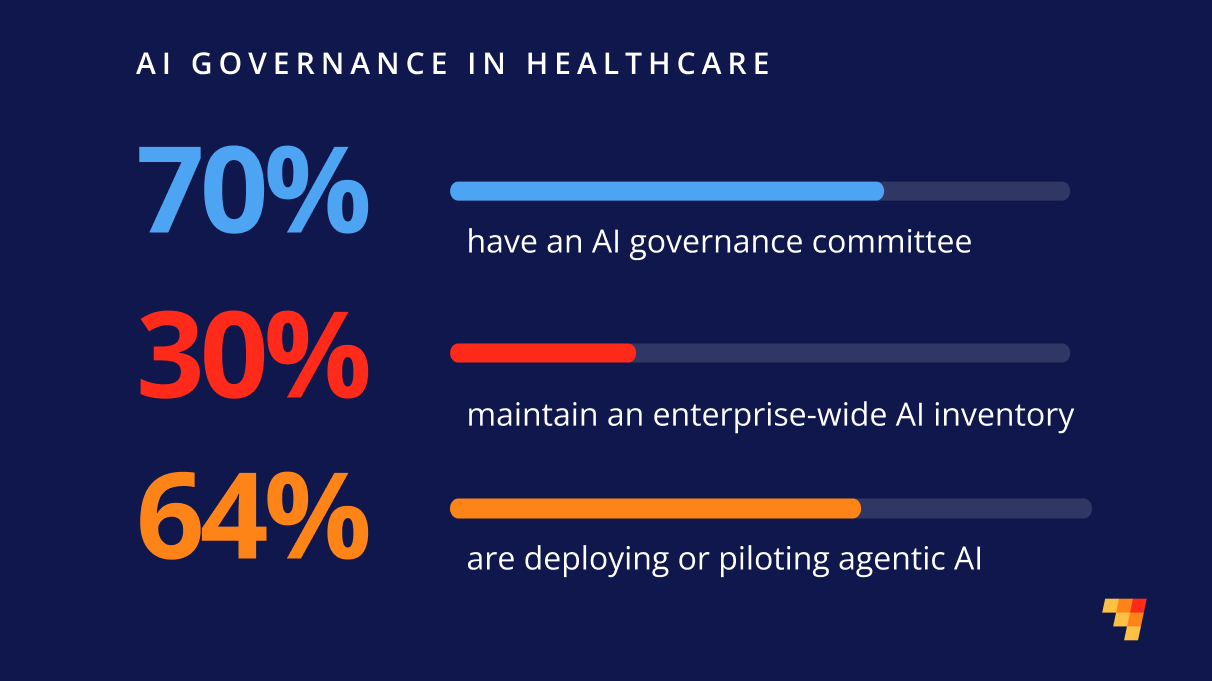
A committee is the starting line, not the finish. The room reflected the numbers. According to the 2026 Healthcare Cybersecurity Benchmarking Study, conducted by Censinet, the American Hospital Association, and the Scottsdale Institute, 70% of healthcare organizations now have an AI governance committee. Around 30% keep a comprehensive AI inventory. And 64% are already testing or rolling out agentic AI, the kind that can act on its own.
Healthcare quickly built its governance foundation for AI. Now, the challenge is to scale that visibility, track these tools in real time, and connect early policy to active monitoring. For clinical IT leaders, that’s the next milestone.
Shadow IT became shadow AI. A decade ago, we fretted over unapproved servers humming away in closets. Now it’s about shadow AI—features switched on within product teams already use, often defaulting to “on” in leading EHR and productivity platforms. Automation tools let savvy users wire models into their workflows, making it difficult for IT to notice them afterward.
One CIO explained how his team scours vendor release notes to identify which AI features might be activated, then decides what to evaluate, document, or disable. Another raised a tougher issue. The same connectors that make these tools easy to adopt also complicate governance. Connecting’s easy but categorizing—that’s the real work.
The sharpest committees focused their question. A pattern emerged from leaders of long-standing committees. They stopped trying to govern everything equally and avoided treating the committee as just another IT security review. Instead, they asked a more targeted, difficult question: What really matters most to us?
Several leaders discussed mapping their critical clinical and business processes, ensuring blood reaches its destination and keeping emergency departments operational, then searching for hidden single points of failure within those processes. The pressing question is no longer just “what AI do we use?” but “what are our critical dependencies, and what’s at stake if they vanish?”
Visibility is really about resilience. The conversation has moved beyond just inventory to resilience. Knowing which AI systems you operate is just the beginning. The greater concern is identifying which dependencies would disrupt care if they failed.
Recent events highlight the need. The Change Healthcare attack illustrated how a single vendor issue can ripple through multiple organizations and delay patient care. The OneBlood ransomware incident had hospitals in the Southeast scrambling when one supplier went offline.
How do you prove ROI? The room eased a bit when someone brought up return on investment. The honest truth is, it’s still tricky to measure, and the teams that see the biggest gains often lie outside enterprise IT. Clinical and operational groups, when given the chance, tend to devise the most innovative use cases. Some systems are intentionally rolling out tools with guardrails. They grant access by request, start with executive teams, and hold internal sessions where staff showcase their creations—rather than flipping AI on for everyone all at once. Why we gather everyone in the same room.
No vendor slide or single best practice can solve these challenges. They become clearer when peers connect openly and share what truly works—without a sales pitch hanging in the air. That was the summit’s purpose, and it’s what Inneo Alliance aims to do. We bring health systems together in a space free of agendas, where tough questions get asked openly and practical solutions are shared.
This was our first time meeting in person. It won’t be the last.
Learn more about how Inneo Alliance partners with non-profit health systems at inneo.health.
Inneo (formerly The Innovation Institute) is owned and managed by a nationwide group of non-profit health systems. We run innovation programs for our members across clinical innovation and business services, embedding alongside their teams at no charge. Inneo identifies the partners best aligned to each system’s priorities, negotiates terms on their behalf, and reinvests the resulting vendor fees back into the program. That flywheel sustains the innovation lab without additional capital calls on members. We are your ally. We are Inneo Alliance.